

Professor Ioanna Sitaridou
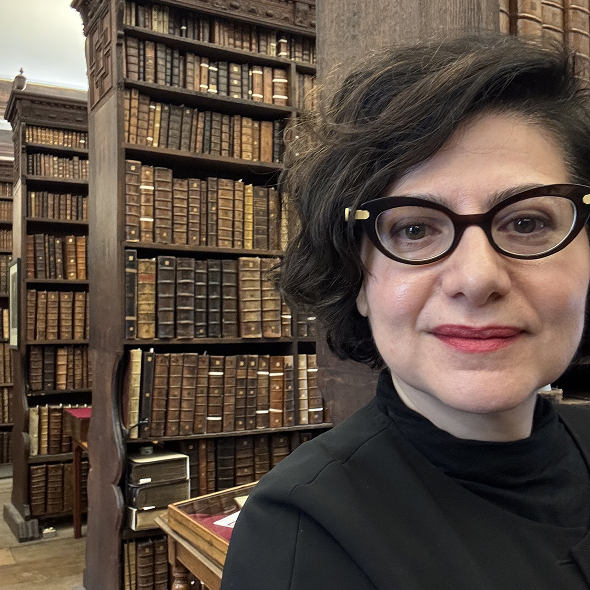
Principal Investigator (University of Cambridge)
Professor Ioanna Sitaridou is the Principal Investigator (PI) of this UKRI-funded project. She is Professor of Spanish and Historical Linguistics at the University of Cambridge and Fellow, Tutor and Director of Studies in Linguistics at Queens’ College, Cambridge. She oversees all Portuguese-related linguistics teaching at Cambridge since 2004 (including teaching of the Cape-Verdean creole); she has been Co-I of a BA/Leverhulme project on “Heritage Portuguese in the UK” (with Prof Michelle Sheehan); she is a fluent L2 Portuguese speaker; and she studied at the Department of Linguistics, University of Lisbon as an undergraduate (ERASMUS).
She has over 60 publications on Ibero-Romance, syntax, language contact, heritage languages, and documentation of endangered languages. In a recently submitted joint paper on Mozambican Portuguese null subjects based on original fieldwork in Maputo conducted by her ex-undergraduate, Thomas McGrade, in 2019, it is claimed that even L1 speakers of nativising L2 varieties behave significantly differently to L1 speakers of the prestige variety, in this case European Portuguese.
She is internationally recognised as one of the foremost scholars working on language change in the Ibero-Romance languages and Greek leading their systematic (micro-)comparison especially of null subjects, objects and clitics, word order, and finiteness. She is known to take ‘orthodoxies’ and turn them upside-down thanks to meticulous consideration of data coupled with cutting-edge linguistic theory. Importantly, the data are sourced following ethnography of communication and her approach to revitalisation is firmly bottom-up. She is one of the key advocates for a holistic approach to language contact, incorporating findings from syntactic theory, variation, language acquisition and sociolinguistics and she has proposed that there is no need for a specialised theory of language contact.
She has been awarded numerous fellowships and visiting professorships at Princeton, Oslo, Harvard, Universidade Federal de Bahia, CNRS-Inalco Paris, and Chicago. She has lectured all over the world delivering over 260 talks and lectures.
She already has extensive fieldwork experience and a strong grounding in anthropolinguistics, developed during her undergraduate studies, during which studied under Prof Lukas Tsitsipis—a fearless and most committed ethnographer with pioneering work on Arvanitika—at the Aristotle University of Thessaloniki. She has been researching endangered and low prestige languages in socio-politically sensitive contexts such as Romani-speaking communities in Dendropotamos, Thessaloniki; Vlach-speaking communities in Trikala; Spanish in La Palma, Canary Islands with the COSER team; Llanito in Gibraltar (with Prof Laura Wright) (see here and here); and Sri Lanka Afro-Portuguese (UKRI-AHRC-funded). Undoubtedly, most of this experience has been gained out of 18 years of field working in Turkey where she took Romeyka out of oblivion, see, for instance the Guardian articles (here and here), Kathimerini (here and here and here), several times on the Today programme in BBC Radio 4 and BBC World Service, as well as The Independent, Der Spiegel, Sabah, etc. She turned this endangered language into a topic of global discussion by publishing papers in international peer-reviewed journals, while putting forward a new phylogeny of Greek positing the existence of more than one Greek language. She used this research and the resulting publicity to educate on bilingualism, promote linguistic variation and self-esteem (see the NYT feature and the GBC one) and self-esteem, especially for female speakers in remote/underprivileged areas, with the aim to promote heritage and endangered languages and cultures as a way of maintaining social cohesion in direct counterpoint to the ideology underpinning nationalism.
Shihan De Silva Jayasuriya
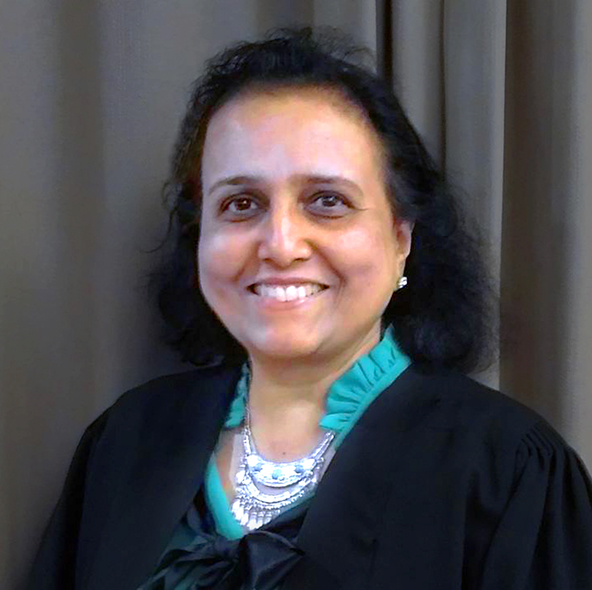
Research Associate (University of Cambridge)
is a Research Associate to this project; an Affiliated Lecturer in the Faculty of History, University of Cambridge; an undergraduate supervisor at the Faculty of Music, University of Cambridge; and also a Senior Associate, Lucy Cavendish College, Cambridge. Dr DeSilva Jayasuriya is leading expert on SLP. She was born in Sri Lanka and she is a native speaker of Sinhala. She has researched and published on nineteenth century SLP manuscripts held in the British Library (London) and in the University of Graz (Austria) bringing to the fore correspondences and essays on SLP by the father of creole languages, Hugo Schuchardt. She has substantial experience field working amongst minority groups in Sri Lanka, especially the community in Sirambiyadiya, both in terms of language and ethnomusicology; the Sri Lanka Malay community, and with the Portuguese Burgher communities in the Eastern Province who speak a variant of SLP.
She has published six books, one co-authored book, five edited books, forty book chapters, sixty-six journal articles, nine encyclopaedia entries and four essays. Her books deal with the grammar and variation of Sri Lanka Portuguese and also its literature and song tradition; contact between SLP and Sinhala; reduplication phenomena in Indo-Portuguese, Sino-Portuguese and Malayo-Portuguese, and Sri Lanka Malay itself, the language of the minority Malay community in Sri Lanka.
Her work —including ethnographic filmography screened internationally—on the history and culture of Indian Ocean migration and diasporic communities in Sri Lanka has made visible, “invisible communities” such as the African-Sri Lankans, , whose ancestors were dispersed from their motherlands due to colonialism and the slave trade.
Chapane Mutiua
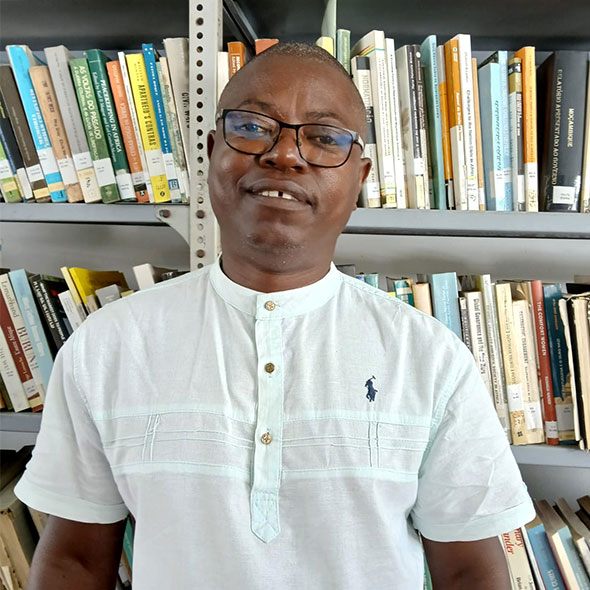
Research Assistant (Eduardo Mondlane University, Maputo, Mozambique)
Chapane is Researcher and Head of Department of Political and Historical Studies, Centre for African Studies, Universidade Eduardo Mondlane, Mozambique. His contribution to this project is his expertise in some of the important languages spoken in northern Mozambique, namely: Emakhuwa, Enahara, Emarevoni, Embamela and Emgovola. He is a native speaker of Ekoti (Bantu), with additional competence in Kiswahili, Kimwani, Arabic, Portuguese, and Xi-Xangana (a language from Southern Mozambique).
His PhD in African Studies at the Centre for the Studies of Manuscript Cultures at the University of Hamburg —currently under completion—is based on Tenzi Literature as source for re-construction of History. Using a Swahili Ajami epic poem, he analysed the process of construction of political and religious identities in the face of African resistance against Portuguese colonial occupation in the region of Angoche.
In his research he combines philological and archival work with fieldwork to research colonialism, Islam and modern Nation State, the discourse about western modernity and development, and slavery and slave trade from northern Mozambique to the Indian Ocean to the Atlantic (e.g., work on Zanzibari Makhuwa community of Durban, South Africa).